Letter Train — an educator's view
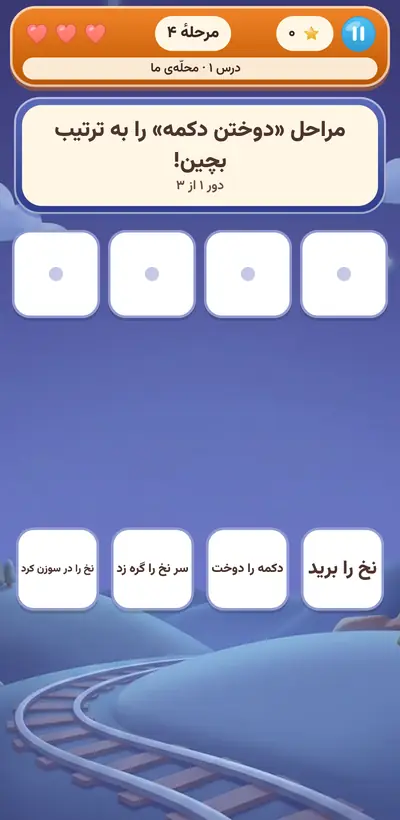
Ordering is one of the hidden but important skills of the Persian lessons: parts of a word in order, words in alphabetical order, story events in time order. In Letter Train, the child taps cards in the right order to fill the top row. Grade 1 arranges word parts; grade 2 arranges the days of the week and dictionary order by first and second letter; and higher grades cover sentences, short stories, the steps of a task, proverbs, and verb tenses.
Dictionary skills
Levels like "dictionary: second letter" and "third letter" push the child to look at the next letter when two words share the same first letter. This is exactly the skill needed to find a word's meaning in a dictionary, and it builds their independence in learning.
Understanding the sequence of events
Arranging "short adventures" and "the steps of a task" helps the child see the relationship between before and after: what caused what to happen next. Understanding sequence is one of the foundations of grasping a story, and a first step toward writing an orderly composition with a beginning, middle and end.
Planning before acting
Before every tap, the child has to decide in their mind which card comes first and which comes next. This short planning, part of the mind's executive functions, becomes richer and more complex in the longer sequences of grade 5 and 6, like "from the distant past to the future".
A card that only wobbles
In this game, only the next card is accepted, and the others just wobble and stay in place. The child can try without fear to discover the order — safe trial and error that replaces worry about mistakes with curiosity.
A tip for parentsPull five books off the home shelf and ask the child to arrange them alphabetically by title. Or mix up photos from a family trip and have them arrange them in the order things happened and tell you the story from the start.
 Nikipoo School


 Grade 140 levels
 Grade 240 levels
 Grade 340 levels
 Grade 440 levels
 Grade 540 levels
 Grade 640 levels