Sound Basket — an educator's view
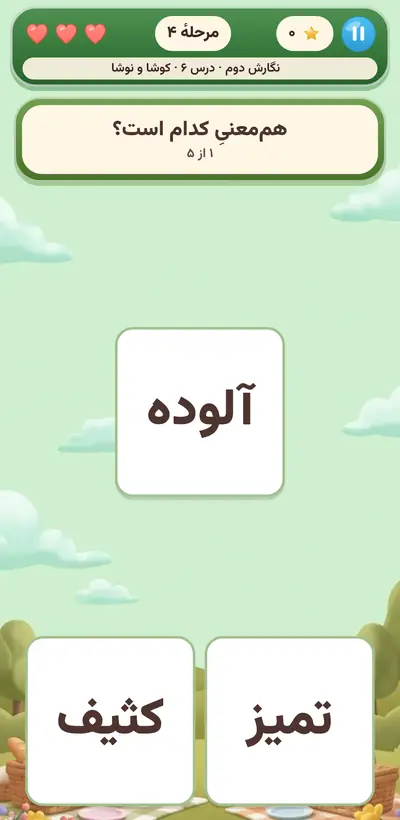
Sorting is one of the foundations of understanding a concept: when a child can say which category something belongs to, it means they've grasped that category's key feature. In Sound Basket, the child tosses each word card into its right basket. In grade 1, this is based on sound and syllable, like “«ب» or «د»?” and “one syllable or two?”; in grade 2, on spelling — «س» or «ص» — and “noun or action word”; and in later grades, nouns, verbs and adjectives, singular and plural, verb tense, pronouns, and past and present stems.
Building a concept through comparison
To toss each card, the child has to compare it against the baskets' features. Repeating this comparison helps a concept like “adjective” or “continuous verb” turn from a memorized definition into something the child can also recognize in new words.
A sharp ear for close sounds
In grade 1, levels like “do you hear the «م» sound?” and “«آ» or «ای»?” practice listening discrimination. The child learns to tell apart sounds that are close to each other, a skill essential for correct spelling and error-free reading.
Grammar awareness in action
When the child tosses words into baskets like “past narrative or past perfect” or “indicative or subjunctive,” they experience grammar not as a definition but in action. This awareness helps them understand the sentences in their textbook more precisely and write more correctly.
The red basket, a chance to think again
If a card lands in the wrong basket, the basket just flashes red for a moment and the card stays put. The child gets a chance to think again about the word's feature and correct it themselves; this experience turns self-correction into a calm, natural habit.
A tip for parentsSet out two baskets or bowls and label each one, say, “noun” and “verb.” Write words on slips of paper for the child to toss into the right one. For a younger child, sort household objects by the first sound of their name instead.
 Nikipoo School


 Grade 1115 levels
 Grade 260 levels
 Grade 355 levels
 Grade 475 levels
 Grade 590 levels
 Grade 675 levels