Persian Calendar — an educator's view
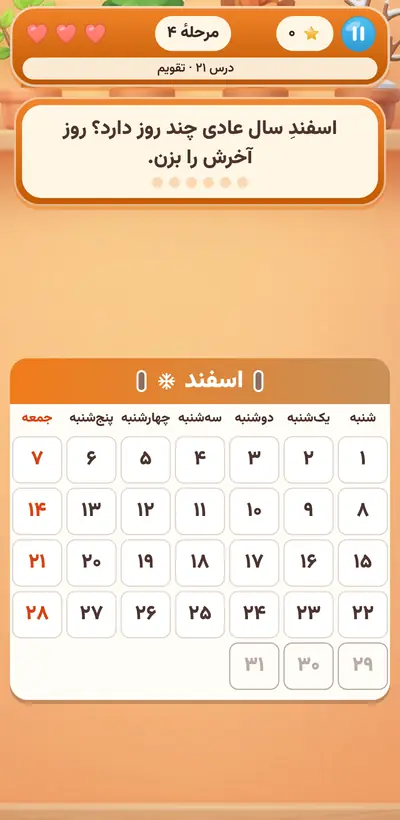
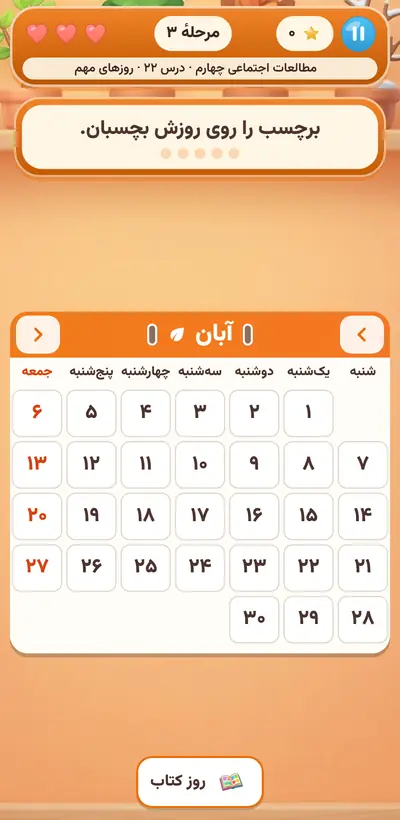
Reading a calendar is an everyday skill that children rarely practice directly. Persian Calendar works with a wall calendar: the child flips a page, finds the requested day, places a month label in its season, and turns the wheel of seasons. Grade 3 practices days of the week, months, Nowruz, and Sizdah Bedar; grade 4 covers 31-day and 30-day months, the short month of Esfand, and leap years; and grades 5 and 6 practice national days, long-range day-counting, and the concept of a century.
Predicting future days
Questions like “how many days are left?” and “what day is the day after tomorrow?” push the child to predict time, not just memorize it. This skill underlies planning: a child who counts down the days to an exam or a birthday is gradually learning to wait and to prepare.
Spotting the pattern in months
That the first six months have 31 days, the next five have 30, and Esfand is shorter, is a pattern. The child discovers it by working with calendar pages, rather than just memorizing it. Pattern-finding is a foundational math skill, practiced here in a completely familiar setting.
Rooted in Iranian traditions
Nowruz, Sizdah Bedar, Iranian celebrations, and the days of notable figures are labels the child places in the right month. This way, the calendar isn't just counting days; it's a shared story that families repeat together every year, bringing the child closer to their own culture.
Maybe you should flip the page
If the child looks for the answer on the wrong page, the game reminds them “maybe you should flip the page!” and the misplaced label returns to the tray. After two tries in a row, the correct page opens on its own and the answer's spot glows. The child sees the way to find it, not just the answer itself.
A tip for parentsHang a paper calendar on the child's bedroom wall and let them cross off the day themselves each night. Mark family birthdays and holidays together, and sometimes ask how many days are left until the next marked day.
 Nikipoo School


 Grade 320 levels
 Grade 421 levels
 Grade 520 levels
 Grade 619 levels