Time Train — an educator's view
Time Train introduces the child to the idea of “order” in social life. A few cards sit on the screen, and the child taps them one by one in the right order to fill the top row: months and seasons, the stages of growing up from baby to elder, a product's path from farm to table, and the widening circle from home to neighborhood, city, and country. In grades 5 and 6, ancient and post-Islamic dynasties, decades, centuries and millennia, and continents and oceans by size are added.
Step-by-step thinking
Arranging farm, mill, bakery, and table one after another shows the child that each step depends on the one before. This “step-by-step thinking” isn't limited to the economics lesson; it helps with multi-step homework, helping in the kitchen, and any complex task.
Nested circles of belonging
The “from home to country” cards introduce the child to the idea that they belong, at the same time, to a family, a neighborhood, a city, a province, and Iran. Understanding these circles helps them see their own place in society and understand why officials and rules differ at each level.
Empathy with the life cycle
Arranging the stages “from childhood to old age” seems simple, but it makes the child think that grandpa was once a child too, and that they themselves will one day grow old. This view makes respect for elders and patience with younger children feel more natural.
Discovering order through a wiggling card
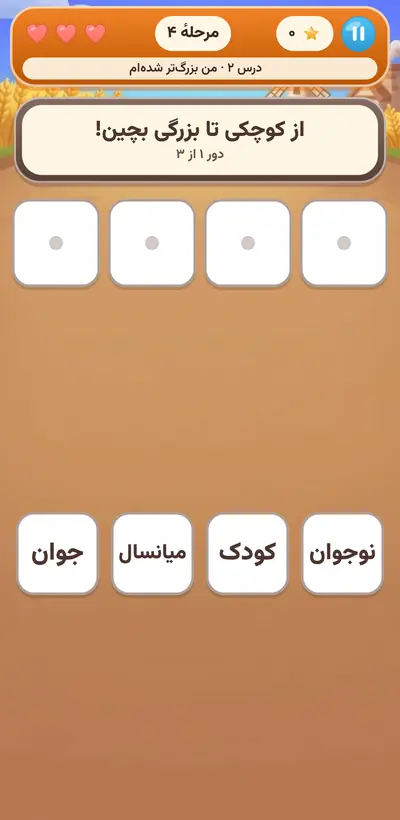
In this game only the next card is accepted, and the other cards just wiggle a little. The child tries a card without worry and gets an immediate answer; step by step they move from guessing to reasoning and discover the order themselves.
A tip for parentsWhile cooking a simple dish, write the steps on separate slips, shuffle them, and let the child arrange them before you start. For older grades, do the same with the names of a few historical dynasties on paper.
 Nikipoo School


 Grade 340 levels
 Grade 440 levels
 Grade 540 levels
 Grade 640 levels