Hungry Croc — an educator's view
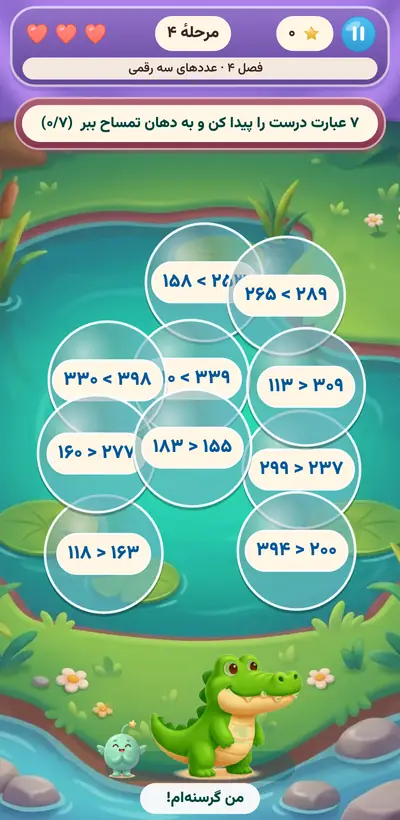
Comparing two numbers looks simple, but place value, fractions and decimals hide behind it. In Hungry Croc, ten expressions like "45 > 23" float on a pond, and the child drags the correct ones with a finger into the crocodile's mouth. In grade 1 the comparison covers up to fifty and the tens; in grade 2 and 3, close three- and four-digit numbers; in grade 4, fractions with equal denominators and unit fractions; in grade 5, closely spaced decimals; and in grade 6, positive and negative numbers.
Judging a statement
Here the child doesn't produce an answer — they judge whether a complete math statement is true. They must read the greater-than or less-than sign, weigh both sides, and decide. This checking skill is exactly what they'll later need to review their own answers on a test.
The highest-value digit first
When two four-digit numbers like close-together nine-thousands sit side by side, the child learns to start comparing from the thousands place, not from whichever digit looks bigger at a glance. This orderly, step-by-step look cements place value in practice.
Revisiting an intuitive belief
A child naturally thinks four is bigger than three, so a quarter should be bigger than a third too. Levels like "the bigger the denominator..." and negative numbers challenge that assumption. Calmly facing such a contradiction is one of the most effective ways to correct a misconception.
A pause on the way to the mouth
Dragging a bubble to the crocodile's mouth, unlike a quick tap, gives a few moments to think. If the expression is wrong, the crocodile won't eat it, an encouraging message appears, and the bubble stays on the pond. The child learns to pause briefly before acting — good practice for impulse control.
A tip for parentsPut two price tags or two house numbers side by side and ask which is bigger and why. For fractions, cut one loaf into three pieces and another into four, so the child sees with their own eyes that a bigger denominator means a smaller piece.
 Nikipoo School


 Grade 134 levels
 Grade 234 levels
 Grade 333 levels
 Grade 433 levels
 Grade 533 levels
 Grade 633 levels