Word Frog — an educator's view
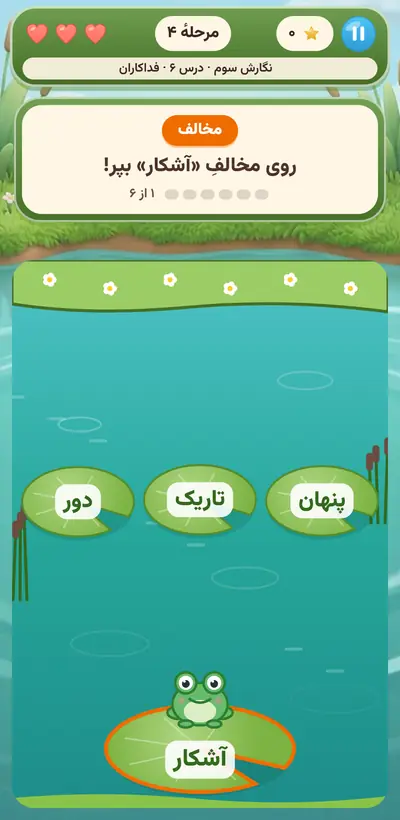
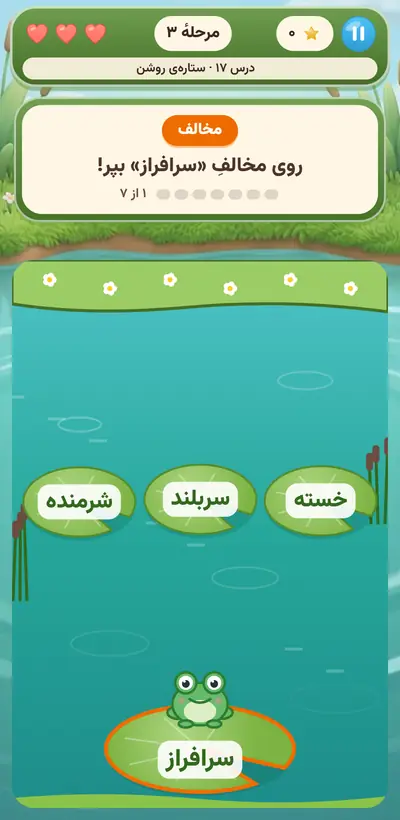
In the vocabulary section of the Persian textbook from grade 3 on, the child constantly has to ask: what's this word's synonym? its opposite? its word family? In Word Frog, the child reads a word, figures out that jump's rule from the colored sign at the top of the screen, and picks, among two to four lily pads, the word that fits the rule. The rule sometimes changes mid-level. In grades 5 and 6, singulars of Arabic plurals, present stems, and homophones join this pond too.
A word's web of meaning
With every jump, the child links a word to its synonym, opposite, or word family. Words get stored in the mind as a web of connections; the more of these links there are, the easier it is to recall a word and understand more literary texts with words like «دلاور» (“brave”), «ژرف» (“deep”), «گیتی» (“the world”).
Mental flexibility
When the rule shifts from “synonym” to “opposite,” the child has to set aside the old rule and think with the new one. This deliberate switching, which psychologists call cognitive flexibility, is one of the key skills of executive function.
A deliberate trap, a deep lesson
Levels like “synonym, not opposite!” and “same family, not same topic!” deliberately include one close, misleading choice — the very mistake often seen in class. The child learns to read carefully before jumping, to see exactly what the rule is asking.
Guidance that gives a reason
If the child jumps onto the opposite leaf when a synonym was asked for, the game tells them “that was its opposite,” and the leaves stay put. After two mistakes, the correct leaf glows. The child understands where their mistake came from and continues without worry.
A tip for parentsPlay “word jump” in the car or at the table: one person says a word and states the rule, say, “opposite of brave.” The next person answers and then states a new word and rule themselves. Sometimes switch the rule suddenly.
 Nikipoo School


 Grade 320 levels
 Grade 420 levels
 Grade 520 levels
 Grade 619 levels